


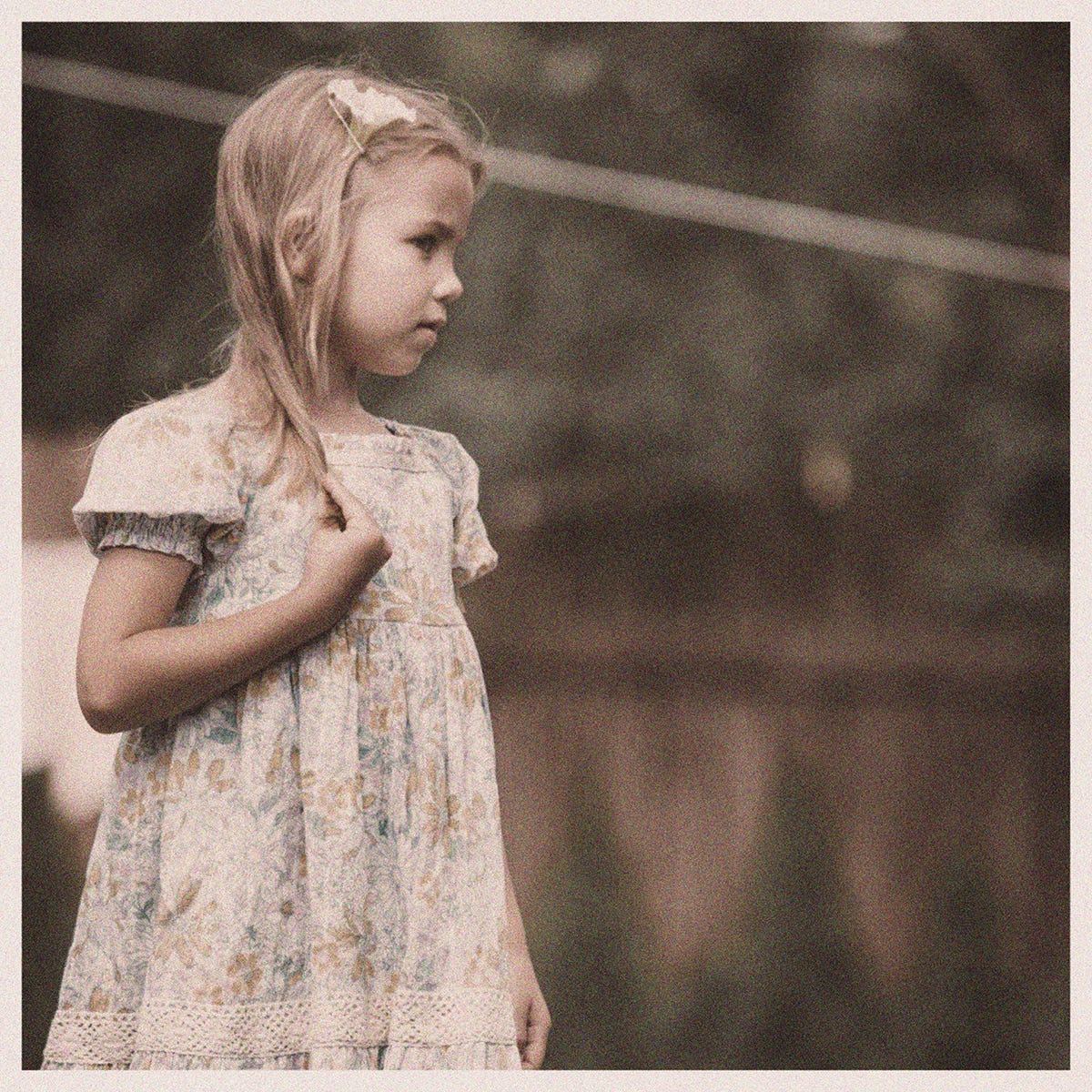
When the last big bundle of the pedophile papers dropped earlier this year, I knew it was time to gather a circle of women. It was time to acknowledge how systemic misogyny impacts the way we see ourselves and move through the world.
Across the globe, the gruesome underbelly of society is being exposed—revealing a pervasive disregard for the tender wholeness of life. It wounds us all. And we needn’t wait for leaders and institutions to acknowledge their complicity in order to face our own.
In these last few months, I’ve been reckoning the ledger of my own heart, untangling the legacy of harm inside myself, and undertaking the gentle work of reconciliation.
I’ve come to recognize that grooming is not limited to predators. In fact, it happens all the time without any awareness of the consequences. Consider the possibility that all of us have been psychologically conditioned for so long that the conditioning itself has become invisible.
For millennia, patriarchal cultures of separation and control have vilified our bodies and our intuitive ways of knowing, isolated us from our naturalness, and distorted our sense of belonging.
Normalized social grooming compels loving parents to teach their children to abandon themselves in order to fit in and stay “safe.” While the specifics of that conditioning can look quite different for boys and girls, the encouragement to reject and mistrust our innate ways of being happens to us all.
What “unacceptable“ parts of yourself have you learned to hide?
A photograph of me at age three reflects the essence of my own childhood conditioning. I’m seated at the breakfast table, hand propped under my chin, frowning over my cereal bowl. A construction paper face is taped up on the wall next to me. On it, my mother has drawn a frowning expression. On the flip side is its smiling opposite.
For years I imagined the flip between happy and unhappy faces was a playful game between me and my mom. On one level, it probably was—but it was not only that.
I’ve wondered: Why, in a lifetime of images, do I keep recalling this one photo?
My recognition: Some part of myself is trying to get my attention.
I’ve come to see the paper face ritual in my childhood kitchen as well-intentioned grooming. My loving mother was blindly passing on a devastating legacy—one she’d inherited long before me. She was teaching me to cover up the messy parts of my humanity, to hide inconvenient and unwanted feelings, and to perform in ways that please others. The ultimate other to please was always men.
Around the time that photo was taken, my parents were approached by the bishop of their church. He’d been concerned about the amount of attention I was receiving for the cute outfits my mother dressed me in. He worried that praise for my clothes would distort my values. A sensitive observation, to be sure. As the story goes, Bishop Bang encouraged my folks to compliment me on my sweet smile—adding something about how my smile reflects my sweet spirit.
Here’s the rub: the hidden message within his genuine care and concern is that girls are supposed to be sweet and agreeable. If we’re not compliant and smiling, we’re not reflecting goodness—or something like that. At the very least, I received the message that feeling sad and angry makes adults uncomfortable—and smiling pleases them. I was being conditioned to hide my naturalness. I was learning that my innate responses were not signals worth hearing, but defects to overpower.
One can argue that compliance makes civilization possible. It’s a common belief that if humans are to live together harmoniously, we must override the primitive and selfish aspects of our human nature.
Yet it seems possible that our so-called “base impulses” may not be born of nature. They may be expressions of an unnaturally inhibited self—distortions that arise in response to being controlled or overpowered.
Perhaps we are collectively expressing an existential wound held in place for so long that we think it’s natural.
I’ve been wondering: What can we do with a wound this old and vast?
It’s a question that wants company. My longing to be held in that inquiry prompted my notion of a women’s circle. A healing ritual. I asked Lisa Iversen—a gifted teacher, facilitator, and wise friend—to guide us.
The intention was to make visible the ways we’ve internalized patriarchal messages and shaped ourselves around male approval—to help something old unwind so something new can be woven. Lisa suggested we call the gathering Hospice for Patriarchy: Unwinding the Male Gaze.
Healing happens where two or more are gathered in love. By setting a date and naming our intention, Lisa and I initiated something—a field of healing. And ancient patterns of disempowerment began to surface almost immediately.
In the weeks leading up to the event, countless small moments, conversations, and dreams revealed to me dynamics I thought I’d unwound years ago. They were lurking in my psyche—less pronounced, to be sure, but still very much part of the show.
A dramatic example arrived just days before we gathered. It was dinner time, and I made an ordinary choice. Something I’ve probably done a thousand times. Simply put, I overrode my body’s clear signal regarding what to eat. It was an expedient choice that allowed me to stay in harmonious conversation with my partner, Stephen, and sidestep the need for deliberation. It was the kind of small, unbidden surrender I’ve made my whole life.
This time, that pattern of dismissing my internal knowing became alarmingly clear. An hour after dinner, a large bony protrusion appeared on my left hand, then my stomach expelled the meal and my left eye swelled up as if stung by a bee.
My body made visible a lifelong pattern of self-override.
Two days later, sixteen women representing four decades of life sat together in my living room. The lump on my hand and swollen eye held steady—reminders of what was urging me to host the gathering.
With skill and care, Lisa directed our focus toward receiving support and blessings—we had all experienced enough harm, there was no need to re-traumatize ourselves in the name of healing. She drummed and guided us into a journey in which each woman met with the girl she once was.
My girl-self arrived wearing a gypsy-style dress and bangle bracelets—small, tender, about five years old. I recognized her from a photograph I’d recently found. Her parents were divorcing. She and her mother had moved into an attic apartment. She had good friends and moments of real happiness. She also experienced complex feelings that had no safe place to land. In that moment, I couldn’t say for sure whether she was fully there or hiding part of herself.
Decades later, here we were, face to face. With my adult-self held by the beat of the drum and a circle of women, my girl-self received a long-awaited blessing—permission to be fully herself. It came from an ancestral source more vast and authentic than any of the adults around her, who were living inside their own forms of self-suppression and unable to bestow that kind of blessing.
Lisa’s drumming concluded and we gathered in pairs to listen and share. The house softly hummed. My heart was full. It seemed to me that a room full of girls were finally exhaling, after decades of holding their breath.
The next morning, the hard knob on my hand was melting like a mound of butter. My eyelid was less swollen too. Something important had happened in that circle and my body reflected it—a reconciliation, a kind of healing. Yet healing is a process.
In the days that followed, the old pattern of self-override showed up again—sneaky as ever. Each time I saw it, I laughed, let Stephen in on the joke, and made a different choice.
Later that week, Stephen and I sat together in another kind of circle, facilitating our bi-monthly support group. Stephen guided us into 30 seconds of pure squiggle—eyes closed, pen moving, no intention. Then we gazed at our scribbles, the way you might look at clouds or tea leaves, and waited for a character to appear. Through a creative process, we developed those characters, and engaged them in imaginal dialogue—a kind of inner conversation.
Within my own squiggles, a female figure appeared. Twisted like a pretzel, she wore tiny ballet shoes and her hair was pulled tight. I named her Henrietta. She looked cranky. I invited her to speak. She didn’t hold back. She was angry about being twisted. She urged me to feel that twist in my own body. I did. My inhale was uncomfortably constricted. So I uncrossed my legs and, together, we took some deep breaths.
Henrietta now sits at my desk—a totem. She reminds me to breathe, to be kind to myself, and to trust my body’s wisdom.
We do not learn to honor others by overriding ourselves.
We learn to honor others by coming home to ourselves.
That paper face in my mother’s kitchen didn’t make me a better person. It made me a better performer. As children we’re subtly taught that a performed self is better than an authentic self. That our inner authority is unreliable. That it’s safer—even wiser—to look outside ourselves for validation, answers, and direction.
Of course, as children, we depend on adult authority figures to survive. The problem is that we are rarely taught how to align with the wise authority inside ourselves. It seems to me that the shift from outer to inner authority is the mark of real maturity.
In my own life and my work with people, I’ve witnessed that the more comfortable we become in our own skin, the less willing we are to hide. The more we trust the inner authority of our bodies and intuition, the less vulnerable we are to manipulation by outer authority.
Coming home to myself is a lifelong practice. It involves recognizing when I leave myself, naming that departure with compassion, then returning—as best I can in the moment. Each time I do, I’m mending the wound of separation.
I am grateful to that circle of women and our girl-selves. What we set in motion continues to unfold. The little girl in the gypsy dress is free to be herself. She knows I’m here breathing with her.
Fantastic. Naming it all so damn clearly. There are so many excerpts here to pull out and read again and again as mantra. Funny that the line that moved me the most was the one where you describe the circle of ‘girls’ talking in pairs. I could feel it, ‘finally exhaling after decades of holding their breath.’ It suddenly felt easier to find our way back even as I know there is so much healing to do, each and every one of us. Like you say the wound is vast. And I see a way home.
Excellent! Thank you for initiating that all important circle of women and their girl-selves... inviting all of us to join in xx